
What led you to enroll at GraSPP?
I had wanted to become a civil servant since my undergraduate days. When I was in the Faculty of Law, there were joint classes with the Graduate School of Public Policy (GraSPP), and there were also seniors of mine who had gone on to GraSPP, so GraSPP was a familiar presence. Thinking it was the choice that would bring me closest to my dream of becoming a “civil servant,” I decided to enroll at GraSPP.
At the GraSPP of that time, as I recall, more than half of the students aspired to the civil service at the point of admission. By the time of completion people went on to a variety of paths, but even so, in the end probably around a third to a quarter of my classmates became civil servants.
After completing GraSPP, I worked at the Ministry of Health, Labour and Welfare for about four years, earned a master’s degree in the data science field at UC Berkeley, stayed on in the United States, and now work as an engineer.
Were there any courses you took that left a strong impression on you?
GraSPP offers courses in a wide variety of fields, and one course that has stayed with me is Diversity and Inclusion, which Professor Kentaro Maeda of public administration taught entirely in English. It was my first time taking a course conducted entirely in English, and there was a discussion every session; I remember having a hard time because I could not keep up with those around me.
There was also a health economics course offered at the Faculty of Medicine, where I attended classes in the medical school’s building alongside doctors and others—a very memorable experience.
Also, in the legislation course, we were taught concrete methods such as how to draft legal documents. For one class assignment, we were handed manuscript paper with grid squares and given homework to write precise text in accordance with the formal rules for drafting legislation, with detailed rules like “leave three spaces here, leave one space before the title…”—I remember being astonished (laughs)
You have earned master’s degrees in both Japan and the United States. Were there differences between university education in Japan and the U.S.?

I earned a master’s degree in the information field at UC Berkeley, and this master’s, too, was professional rather than research-oriented, so it was similar in form to GraSPP: there was no thesis submission, and you basically took various courses and carried out a group project in the final semester to graduate.
It is often said that at universities overseas it is hard to earn many credits in one semester, or that the preparation and review are demanding, but in fact I feel they are not so different from Japanese universities. I do not know much about the undergraduate level, but my impression was that life at GraSPP and graduate school life in America are quite similar. That said, in America there were many group assignments. Also—this may be unique to the graduate school I attended—there were courses where we actually took the City of Berkeley or NPOs in the city as clients, doing consulting or using technology to solve the problems they faced. In terms of engagement with the real world, it may be stronger than at Japanese universities.
Can you tell us about the connection between what you learned at GraSPP and your work at the Ministry of Health, Labour and Welfare, where you took your first job?
Some of the courses I took at GraSPP related directly to my work at the ministry, and some did not. With the legislation course on how to prepare administrative documents, or Policy Process, a course on the flow of how laws come into being, I actually came to be involved at work in events exactly as I had learned them in class—for example, the flow in which an advisory council is convened, a government proposal is deliberated, and the bill is submitted to the Diet—so at those times I did have the sense of having done preparatory study in class.
That said, there was more that I learned through the work itself, and for daily duties I feel I drew more on the knowledge acquired through work.
You presumably had becoming a civil servant in mind at the time of admission. How did the learning you expected when you enrolled compare with the degree to which it was realized?
My goal was to become a civil servant, and I entered the Graduate School of Public Policy as a means to that end, so I was able to achieve that objective. In fact, I did the ministry recruitment visits in my first year and received an offer, so I completed nearly all my credits in the first year, and in my second year I earned credits while working and graduated.
Having experienced two different fields—national civil servant and engineer—how do you feel?
Staying in America and becoming an engineer was not an easy choice. But within myself it has been consistent: I have always wanted to do work that solves society’s problems and challenges in order to be useful to the world, and that leaves a positive impact on the world.
At first I thought I would realize that in the form of being a national civil servant. Wanting to be involved with all kinds of issues from the cradle to the grave, I worked at the Ministry of Health, Labour and Welfare. As I actually worked, I saw good sides to the organization being large. The impact, effects, and influence of projects are enormous, and that appeal was there; on the other hand, whatever you tried to do required coordinating with many stakeholders, and even when I thought “wouldn’t it be better to do it this way?”, it was not an environment where that could easily be realized, so I felt the limits of what a single person can do.
Amid that, I was drawn to the free climate of America, and to the fact that as an engineer, through technology, even one person or a small group, even with a small product, can leave a large impact, and I came to think I would take on the challenge in America.
I spent two years studying tech and programming at graduate school, but I thought that studying in an educational setting and the knowledge you learn through work would differ somewhat, and the desire to know the field better also became a driving force behind my career change.
It seems that fewer students aspire to the civil service these days. What is your impression?
Perhaps it is not my place to say, having moved from the civil service to a private company (wry smile), but I became a national civil servant as my first career, and I felt that the rewards and impact of civil service work are unique to the national government; the dedication to public service, the breadth of perspective, and the passion of the people I worked with—including my cohort at my workplace and my counterparts at other ministries—were tremendously stimulating. I do feel it is a shame that more people are not choosing the civil service as their first career, but I believe mid-career hiring slots have been expanding recently, so becoming a civil servant later on is very much an option, and I think the government side, too, should further develop environments where such people can thrive.
Finally, please give a message to students.
At GraSPP you can take courses freely, so I think it is very important to proactively choose for yourself how you will shape your own career. As one method that might be useful for that, I recommend trying, even in Japanese, to create an American-style resume once.
A Japanese-style CV is a format that simply lists your history in a matter-of-fact way, but an American-style CV or resume is designed to concretely showcase things like the experience you gained in a given position, or, for university as well, what courses you took and what you learned. It was only when applying to graduate school in America that I first wrote, after stating that my first department was here and my next department was there, in fine detail what I did and what I learned in each. I felt that was the first time I seriously looked back on my work history and was able to re-examine my career with a broad vision.
I hope all of you will try making a resume of your present self, and think about what you would like yourself to be like two years and five years from now. There is a platform widely used in America called LinkedIn, something like a Facebook for working people, where many people write their profiles with a level of detail comparable to an American-style resume. By looking at those—especially if you are about to choose a career that is a bit different from others, or rare, such as STEM × public policy—I think it is a good idea to look for people who resemble you and visualize the resume of your ideal self.
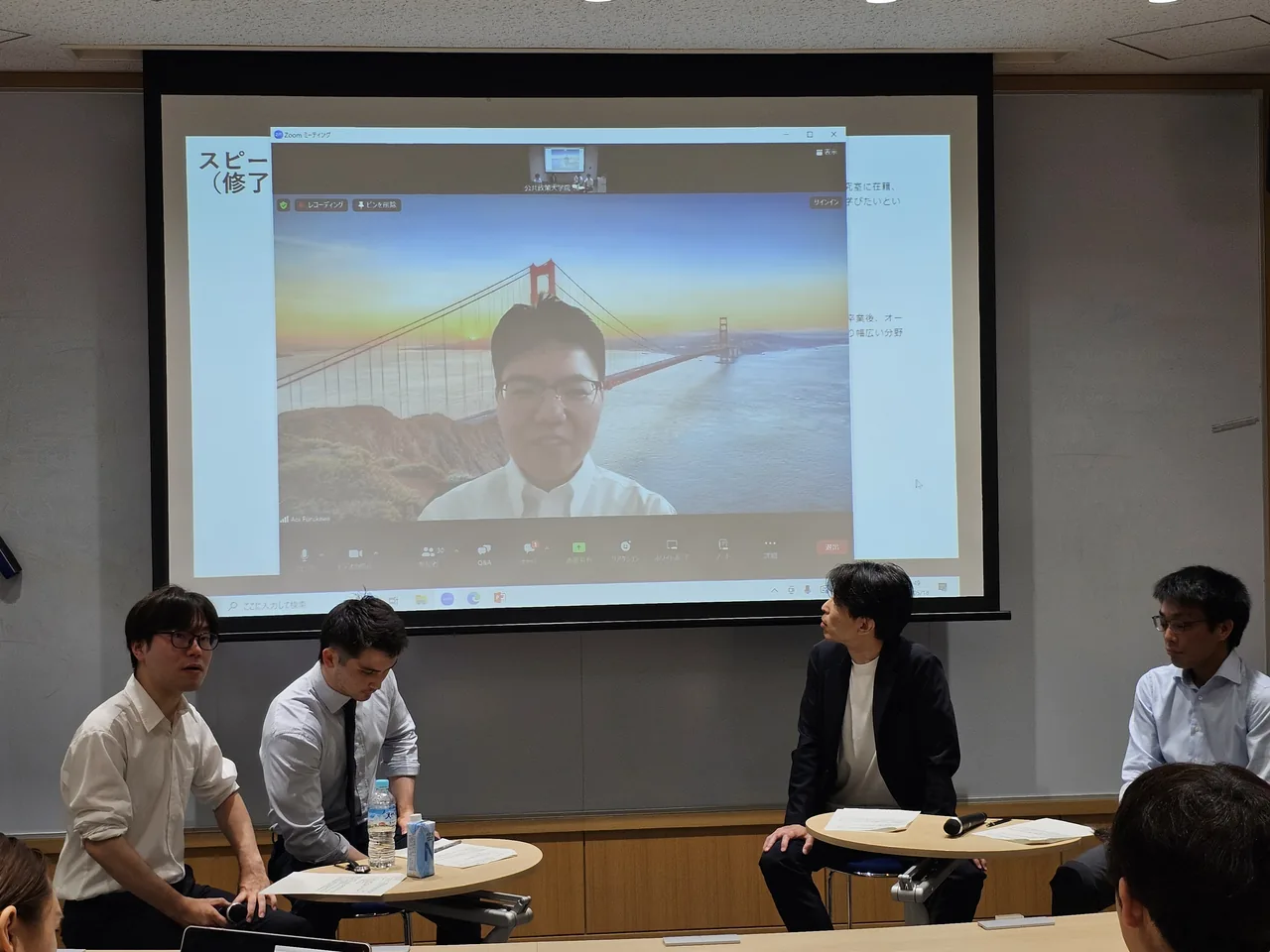
*This article has been edited based on the talk given at the public policy talk event “STEM × Public Policy” held on May 18, 2024.