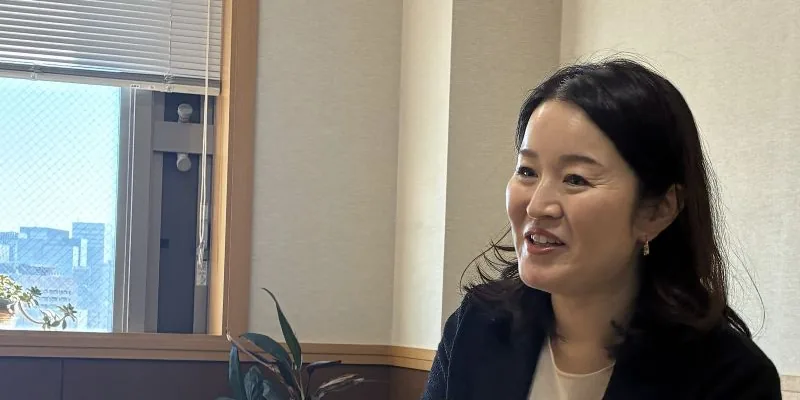

Biography
Graduated from the Faculty of Economics, Kyoto University, and earned a master’s degree in urban policy from the London School of Economics and Political Science (LSE). Joined the Ministry of Land, Infrastructure, Transport and Tourism (MLIT) in 2003. After serving in posts covering public transportation, tourism, and regional policy, she became Director for Tourism Strategy in the Tourism MICE Promotion Office of the City of Kyoto’s Industry and Tourism Bureau in 2014, Deputy Director of the Environment Policy Division in MLIT’s Policy Bureau in 2017, and Planning Officer at the Reconstruction Agency in 2019. She has held her current position since 2021. She is from Oita Prefecture.
Project Associate Professor Mayo Mieno of GraSPP is a former government official who played an active role in tourism and urban policy at the Ministry of Land, Infrastructure, Transport and Tourism (MLIT). In particular, she devoted herself to promoting "Green Slow Mobility" (hereinafter "GSM")—small, low-speed electric vehicles with a low environmental impact that travel on public roads at speeds of 20 km/h or less—and is the one who gave it its name. Today, while teaching at the Graduate School of Public Policy (GraSPP) at the University of Tokyo, she pours her heart into spreading GSM as chairperson of the Green Slow Mobility Council, a general incorporated association. In July 2025, she invested her own personal assets to establish the business company "Slow World" and became its representative. We explored the roots of the convictions of Ms. Mieno, who is devoting her life to realizing a "society where people can move slowly."
―― What led you to aspire to join MLIT?
Project Associate Professor Mayo Mieno (hereafter Mieno): I am from Oita. When I was in junior high school, the first expressway came through Oita, and locally it made life enormously more convenient. And yet, the national news criticized it as “a wasteful expressway that no one drives on.” People who did not live in Oita and had nothing to do with us were dismissing what was, for us, precious infrastructure as “waste.”
I felt intense discomfort with those city-centered values. “If people who live in the regions and understand them do not think about the regions, things will go wrong.” Out of that sense of crisis, I came to aspire to MLIT, where I could be involved in regional infrastructure and regional development.
―― From a prefectural high school in Oita, you went on to Kyoto University.
Mieno: As a child I had hardly ever left Oita, but after visiting Kyoto for the first time on my junior high school trip I fell completely in love with it, and I went on to the Faculty of Economics at Kyoto University.
As a student, I also worked part-time at a long-established ryokan inn. While putting away futons and serving in-room meals, I was awed by the skilled work of the itinerant nakai attendants (note: women who travel around the country working at one ryokan after another), and was deeply moved by unexpected kokorozuke (tips) from guests. I feel I learned firsthand about the relationship between “service” and “the town.”
Encountering the “Petit Train”
―― Working part-time at a Kyoto ryokan is a precious formative experience of tourism services. Was your interest in “slow mobility” also connected to a tourism experience?
Mieno: It began in the UK, where I stayed from the autumn of 2011 on government-funded study abroad, when I encountered what is called the “petit train”—a small steam-locomotive-style vehicle like an amusement park ride. It is a vehicle that travels slowly along the streets of a town.
The first time I rode one was in the city of York in northern England. As I was heading from the station to the railway museum, a petit train came up to the station front, and I was thrilled: “What! I can ride such an adorable vehicle to the museum!” It is very low-speed, slow, and you can leisurely enjoy the journey itself. From then on I was completely hooked, and whenever I spotted a petit train while visiting a European city, I would always jump on.
The petit train has a charm all its own. Ordinary travel goes from A to B, but the petit train goes from A to A—you tour the route along the way and come back. It is a vehicle for tourists, and in terms of function alone it may be something you “could do without.” But I believe it is precisely such “things you could do without” that give a town depth and create enjoyment and richness. Japan, too, ought to have “a little different, slow, and fun” ways of getting around. That feeling kept smoldering inside me.
―― After returning from your studies in the UK, you were seconded to the tourist city of Kyoto.
Mieno: Before studying abroad, when it came to urban policy my eyes had been fixed only on the hardware side—station-front development, buildings, and so on. But through my studies in the UK, I developed an awareness of software-side issues in urban policy, such as diversity and international reputation, and in Kyoto I was able to put that fully to use.
In July 2014, Kyoto City won first place for the first time in the reader-voted ranking of the world’s most popular tourist cities in the influential American travel magazine Travel + Leisure. It was only about a week after I had taken up my post in Kyoto City’s Industry and Tourism Bureau as Director for MICE Strategy Promotion in the MICE Promotion Office. At first, everyone’s reaction was little more than, “Oh, so we were chosen.”
However, after the city was ranked first in the world for the second consecutive year the following year, large numbers of foreign group tourists began to pour in, and we came to face a variety of problems.
From 2015 onward, “overtourism”—where an excess of tourists harms the local community—came to be sharply criticized in various media. For example, illegal private lodgings increased explosively, and some of the bus routes that serve as a vital means of transport for residents became chronically overcrowded. The residents of Kyoto, who had carefully protected their town, found their safe and secure daily lives under threat.
What Nurtured Kyoto’s Beauty
At the time, when we asked foreign visitors to Kyoto for their impressions, the overwhelming response was that “the town was very beautiful.” Behind that lies a long history in which the people of Kyoto have, as a daily custom, swept the street in front of their homes and passed down, generation after generation, traditional festivals that demand both money and painstaking effort.
The number of tourists staying in machiya townhouses was also growing, and they had become one of the city’s attractions—but when a machiya needs renovation, the reality is that private individuals bear costs on the order of hundreds of millions of yen. These countless “untold everyday acts,” carried on continuously by local people, are what slowly cultivated the beauty and the brand of the city of Kyoto. Kyoto’s appeal exists only because of the “cultural capital” of its citizens.
So Kyoto City set its targets not by “numbers,” such as the number of visitors, but by “quality,” namely the number of overnight guests. In other words, we placed the emphasis squarely on having people stay overnight and spend money in Kyoto City, and made the wealthy our main target. The aim was to position Kyoto City anew as a true “number one tourist city in the world.”
Because the shortage of accommodation was pointed out as a reason for the rise in illegal private lodgings, I first put effort into attracting world-renowned luxury hotels. As a result, hotels increased on the south side of Kyoto Station, where there had been few accommodations, and luxury hotels from Japan and abroad, such as the Ritz-Carlton, increased considerably. We also promoted whole-building machiya rentals. In Kyoto, I learned firsthand the difficulty of steering the balance between development and “slowness."
"Green Slow Mobility,” a Name She Coined Herself
―― Did your firsthand experience in Kyoto also inform the concept of “Green Slow Mobility,” which aims for “slowness”?
Mieno: I launched GSM around the time I became a deputy director at MLIT at age 38, giving it the name “Green Slow Mobility” myself. It refers to public mobility services for moving slowly around town using small electric vehicles, like golf carts, that seat four or more people and travel at speeds under 20 km/h.
We began it as an initiative to realize the “integrated improvement of the environment, economy, and society” based on the Paris Agreement adopted in 2015. It sought to spread low-carbon mobility through measures such as securing intra-regional transportation in aging communities and developing new tourism mobility that could become a tourism resource. Because the vehicles are small, their strength is that they can be used for touring sightseeing areas and as a means of transportation for the elderly. The image was of connecting the petit train I had come to know in Europe with Japan’s practical mobility policy.
But what I keenly realized here was that “merely creating a policy does not make it spread, and it does not reach those who need it.” Someone waves the flag for the policy, someone walks alongside and explains it carefully, patiently clears up misunderstandings—unless a policy passes through a “process” mediated by people’s commitment like this, it will not take root on the ground. In Kyoto, the genuine enthusiasm of the city staff became a major force in moving tourism policy forward. With GSM, there were many situations where, despite real needs, nothing on the ground was changing at all, and I keenly felt that society needs someone to wave the flag.
Also, someone once said to me, “GSM is just a boom, isn’t it?” It is true that many mobility-related policies attract attention for a time and then quietly fade away. But if the facts and data the GSM policy has left behind are brushed aside with a single phrase—“it’s just a passing fad”—without being properly examined, the chance to deliver the policy to the communities that truly need the service could be lost forever.
Was it acceptable for the seedling of the policy to be forgotten and disappear as ministry personnel rotations brought one new person in charge after another…? Before long, the thought would not leave my head: “Rather than returning to the ministry to do other work, wouldn’t it be better for me to devote myself to spreading GSM?”
From “Policymaker” to “Flag-Bearer”
―― The decision to leave MLIT, where you had devoted yourself to policymaking, cannot have been an easy one.
Mieno: Actually, from around the age of 30 I had vaguely thought, “Maybe I should leave the ministry by the time I turn 50.” I felt it would be a little bit of a waste to end my life with nothing but the experience of a civil servant. I had come to GraSPP for four years in the form of “research leave” from MLIT, and I was originally due to return to the ministry when my leave ended in March 2025.
To be honest, when the offer of secondment to the university first came, I resisted quite strongly—“If I go to a graduate school, what happens to my career?” That was because, at the time, there was a post at MLIT that I had, in my own way, aimed for since I was young. But by then, the possibility of my reaching that post in terms of seniority had all but vanished while I was at the University of Tokyo. So I spoke with my superior again and asked, “Please let me throw myself fully into GSM research and dissemination at the University of Tokyo,” and was told, “Do as much as you like.”
In that sense I was fortunate, but the promise I had made to myself—“quit by 50”—remained in a corner of my mind. And I reached the conclusion that to make the GSM I had created not “one of the government’s programs” but “a matter of course in society,” it would be better to let go, for once, of my position as a government official.
―― What does Slow World, the company you founded, do?
Mieno: Slow World is a company that aims to “create and sell the things and mechanisms needed to build slow towns.” Into the company name I put the wish “to create a society in which, by being slow, the world becomes a happier place.”
Wanting to Design “Slow Towns”
For example, along roads in Europe there are charming signs that display a smiling face when a car is within the speed limit and an angry face when it goes over. As a business, I would like to try developing a Japanese version of those signs. I am also thinking about making uniforms for GSM drivers. At present, local volunteers often drive in clothes they have prepared themselves, but proper uniforms would lift their spirits, and it would make a delightful sight in the townscape as well. Even starting from small things, I want to design “slow towns.”
The Green Slow Mobility Council, a general incorporated association launched just recently in September 2025, currently has about 60 participating organizations. Municipalities, consulting firms, vehicle manufacturers, and other organizations interested in GSM come together to share solutions to institutional issues and know-how for introducing GSM. I want the goal to be not “how many vehicles to introduce nationwide,” but building a framework in which “regions that want to introduce GSM can do so smoothly.” Lowering institutional walls to reduce the hurdles to adoption, and delivering the necessary information in an easy-to-understand way—that, I believe, is the council’s role.
”Slow” and “Unhurried” Are Not the Same
“Slow” (osoi) and “unhurried” (yukkuri) tend to be thought of as the same, but to me they are completely different. “Slow” means taking more time compared with someone else. “Unhurried” means taking time over the same action at your own pace.
When passing through the ticket gates at a station, have you ever found yourself walking faster than you really needed to, simply because someone was behind you? That is how we live—constantly minding those around us, always rushed. There are probably a great many people who find life hard amid all this: elderly people, for example, people with physical disabilities, people with small children… Shouldn’t we all be a little freer to live by our own axis?
Pouring Her Own Assets into GSM
Since going independent, I am often asked, “What did you do about money?”—I took the plunge and invested my own retirement allowance into these activities. GSM is, to me, like my own child. Though I have left the ministry, I am still working in cooperation with MLIT, and have only just begun the trial and error of spreading GSM.
I cannot yet put my personal “final goal” into words. The one thing I can say is this: “For the rest of my life, I want to keep doing, in my own way, what only I can do.” I hope that as people’s perception of getting around changes—coming to feel that “it’s fine to go slowly”—it will make society even a little easier to live in.
(Interview and composition by Ayako Hirono, Specially Appointed Professor, Faculty of Policy Management, Keio University)