
Why I Went to Graduate School: The Personal Is Political
I had been interested in gender inequality since my undergraduate days, and at the consulting firm I joined as a new graduate, I worked on organizational culture reform and related initiatives through DEI (Diversity, Equity, and Inclusion) consulting. As I dug into the factors producing gender disparities across every domain—companies, government, and beyond—and engaged in designing strategies and introducing systems to resolve them, what I came to feel keenly was that “the personal is political.”
Take the gender pay gap, for example. Japan’s gender pay gap—the largest among the G7 countries*1—cannot be explained by mere “differences in ability” between individuals. Numerous studies have shown that behind it lies a “social (structural)” power balance: “occupational segregation by gender,” whereby women tend to be concentrated in low-paid occupations; “segregation by employment type,” whereby women tend to be concentrated in unstable forms of employment, typified by non-regular employment; and the influence of “gender role attitudes,” whereby the burden of unpaid care responsibilities such as housework and childcare falls disproportionately on women, making long-term employment difficult.
Beyond the gender pay gap, I began to notice that the “personal” worries and hardships often dismissed as not worth mentioning—such as the gender imbalance in decision-making positions and workplace harassment, which I frequently confronted through my work—when their causes are analyzed, often turn out to be connected not to problems borne by individuals, but to problems rooted in social structures. Precisely for that reason, I came to think that rather than pinning the resolution of the hardships of each person—above all women and other minorities in vulnerable positions in society—on “individual effort” or “personal responsibility,” directing it at the “workings of society” would offer a more fundamental solution. Wanting to learn how to formulate the “policies” that shape those “workings of society” is what first sparked my interest in entering GraSPP.
What I Gained from Studying at Both GraSPP and SIPA: Social Change Requires Changing “Tatemae”
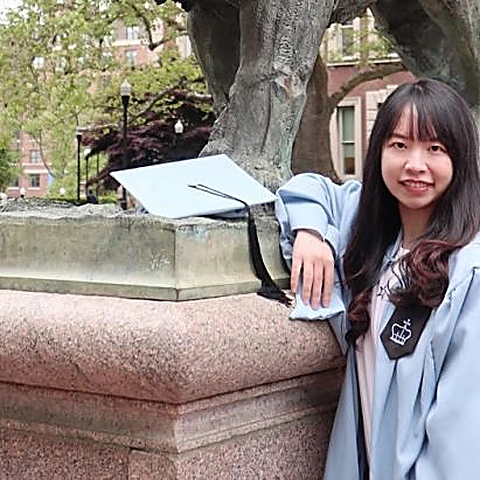
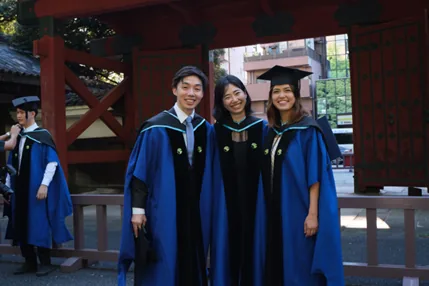
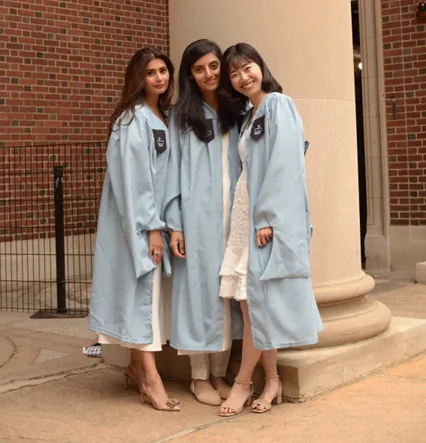
While enrolled, I was also given the opportunity to participate in the Double Degree Program with Columbia University’s School of International and Public Affairs (SIPA) in the United States. In my first year at GraSPP, I acquired foundational knowledge across several related fields—politics, economics, public administration, law, and more—and on that basis learned the full flow of policymaking, from evidence-based policy formulation processes to ways of engaging stakeholders. In my second year at SIPA, I was able to deepen my studies, centered on the approach of “Gender Mainstreaming”—formulating policy through the gender lens that is my specialty.
Across my two years of graduate study, the insights that struck me most were a line from a book*2 a friend I met at GraSPP introduced to me—“social change is not a change in honne (true feelings) but a change in tatemae (public principles)“—and the words of the professor who served as my thesis adviser at SIPA: “There are three stages to ‘understanding’—comprehension, acceptance, and empathy—and you need not aim for acceptance or empathy from the start. Policy is what creates a society-wide common understanding by fostering comprehension.”
Until then, I had thought that “social change” meant not only changing “tatemae” through laws and institutions, but also winning over more people’s acceptance and empathy and changing each person’s way of thinking and mindset—their “honne”—so this was eye-opening. Precisely because changing people’s honne is exceedingly difficult, the approach of first changing tatemae through policy and thereby gradually prompting honne to catch up struck me as revolutionary, and at the same time as a way of proceeding that truly made sense to me.
Laws, public policies, administrative systems, and the like ought to be the collective expression of each person’s wish—“this is the kind of society I want to live in.” Precisely because all kinds of people exist in society, what I now think, having been through graduate school, is that I want to build mechanisms through policies and institutions that remove the hardships of as many people as possible. And I believe that resolving, through policy, the inequalities and disparities that produce each person’s hardships, and making “tatemae” fairer, may in time also gradually change the “honne” within individuals, such as feelings of prejudice.
Working at the United Nations (UN Women): Building the “Tatemae” of International Norms
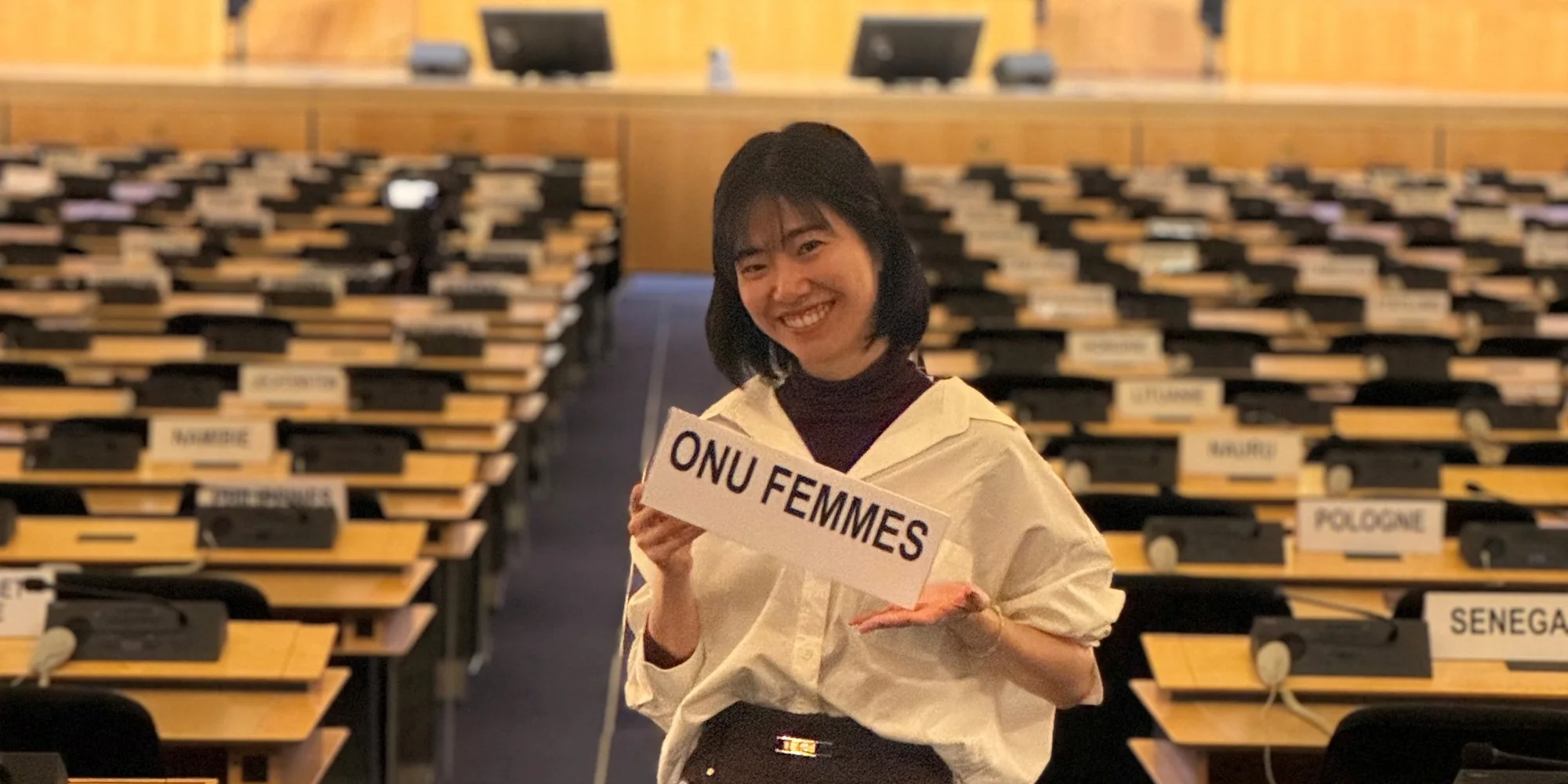
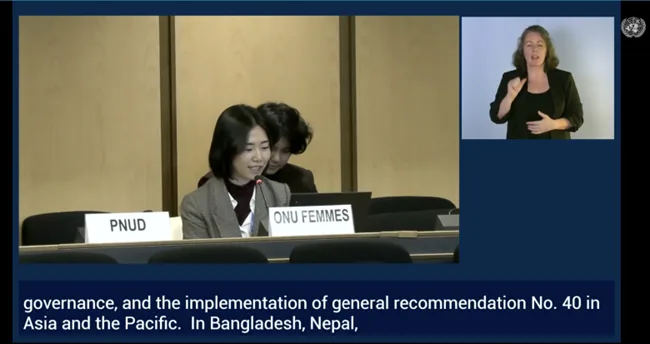
Now, two years after completing GraSPP/SIPA, I work as a gender policy analyst at UN Women, a United Nations entity in Geneva, Switzerland, under the JPO (Junior Professional Officer) programme3. My main work is advocacy: engaging UN member states so that gender perspectives and issues concerning women’s rights are incorporated and considered in deliberations at the Human Rights Council4 and in the draft resolutions adopted by the Council.
When people think of work at the UN, development assistance in developing countries and the like probably comes to mind, but the UN in fact also has the role of establishing international law and treaties—building a common understanding for the world, that is, a “tatemae” shared across the entire globe. This building of “tatemae” is called “Normative Work” at the UN, and drawing on what I learned at GraSPP and SIPA, I am privileged to play a modest part in formulating the “tatemae” of international law and international norms toward the realization of gender equality, and I work every day with a great sense of fulfillment.
In Closing: Cherish the Unease Within You
What those engaged in policymaking should be thinking about, in a society where disparities and inequality remain, is surely not how those who have experienced injustice are to survive, but how to change this unjust and unequal society.
Both when I was involved in advancing gender equality at Japanese companies as a consultant, and now as a UN staff member working toward the establishment of international law, what I hold dear is the perspective that “the personal is political.” I feel this perspective is essential not only when dealing with gender issues, but in confronting each and every social issue, gender-related or not.
I have been extremely fortunate: because I was able to pursue, as I wished—through my undergraduate years, my working years, and my master’s years—the sense of “wait, something’s off” I had felt since childhood, I was able to encounter the perspective of “the personal is political,” which has now become my compass. That I was able to keep pursuing that tiny, tiny sense of dissonance that had always been within me was, to be sure, thanks to the support of those around me who understood and encouraged it; but if any of you reading this article carry a sense of “wait, something’s off” of your own, I hope you will consider, as one option, the challenge of pursuing that small unease at GraSPP rather than sealing it away. If you will have me, I would be honored to cheer on that challenge with all my heart as your head cheerleader.
(* Ms. Nakayama’s study abroad report can be viewed here.)
[Postscript]
This article reflects the author's personal views and does not represent the official views of her organization.
[Notes]
*1: OECD, Gender Wage Gap, 2024
*2: Chizuko Ueno and Suzumi Suzuki, Genkai kara hajimaru: Ofuku shokan [Starting from the Limits: An Exchange of Letters], Gentosha, 2024
*3: A programme under which international organizations accept young professionals on the condition that the costs are borne by national governments; Japan, too, seconds personnel to the United Nations and other international organizations through several ministries, including the Ministry of Foreign Affairs
*4: An intergovernmental body of the United Nations that monitors and investigates human rights violations in countries around the world and issues recommendations for improvement