
What led you to enroll at GraSPP?
After graduating from the civil engineering department of the Faculty of Engineering, I entered the Faculty of Pharmaceutical Sciences, and after graduating I joined the Kumamoto Prefectural Government. As I worked on a variety of jobs I faced all sorts of challenges, and while thinking through my own grounds for judgment, explaining them to the approving authorities, and moving policies forward, I could never quite be confident in daily work whether the breadth of my thinking space was sufficient for the task, or whether what I was presenting was solid enough. It was then that, by chance, an internal call for applicants at my workplace for secondment to GraSPP came up, and I applied.
I had long had the desire to go back and study somewhere, but I was married at the time, and studying at a graduate school, for example, would have meant taking two years off work, with tuition costs on top of that—quite a high hurdle—so I was blessed with a great opportunity at just the right moment.
GraSPP has many working professional students, and besides me there were people who had come from various government agencies, which made it very stimulating.
Were there any courses you took that left a strong impression on you?
I took a variety of courses, and each was very interesting, but among them the course that remains in my memory was one on scenario planning. Scenario planning is a method in which you research a wide range of facts, analyze their relationships, and, from the results of that analysis, draw up various scenarios of how the future will unfold. “Public policy” spans an extremely wide range of fields related to practice, with all sorts of elements intertwined.
I went on to GraSPP with the desire to acquire a kind of fundamental thinking strength—how to read various givens and pieces of information in my own way, and how to put them together—so I think it matched what I most wanted to learn.
How have what you learned at graduate school and your STEM background come together to serve your current career?
After completing GraSPP, I was assigned to the prefecture’s planning division. With all kinds of information flowing in, the fact that I had taken in such a wide range of topics at GraSPP helped me greatly, I believe, in being able to make connections among various pieces of information.
Also, when you are close to frontline practice in local government, there are aspects where you cannot easily find time to look carefully at developments at the national level, but GraSPP has many faculty members who are national civil servants, and I was able to learn a great deal about the policy process in Kasumigaseki, which deepened my understanding.
As for the connection with my STEM background, it serves me in terms of logical and comprehensive ways of thinking, and in my posture toward thinking. That has become the basis of my actions and thought, and I feel it has become a very great strength.
Please give a message to students.
Speaking as someone who enrolled quite a long time after becoming a working adult: once you become a working adult and start a job, you come to hold a clear sense of purpose of your own. Learning after becoming a working adult has the virtue, I think, that you can learn in line with that sense of purpose. For that reason, in my own case as well, my motivation for learning was completely different between when I was actually an undergraduate and when I studied at GraSPP, and I feel that what I gained was completely different too. So it is by no means too late after becoming a working adult—on the contrary, I think going on to graduate school after entering the workforce is also extremely meaningful. GraSPP surely has something that working professionals can learn as well, so if you are interested, I would be delighted if you would consider it positively.
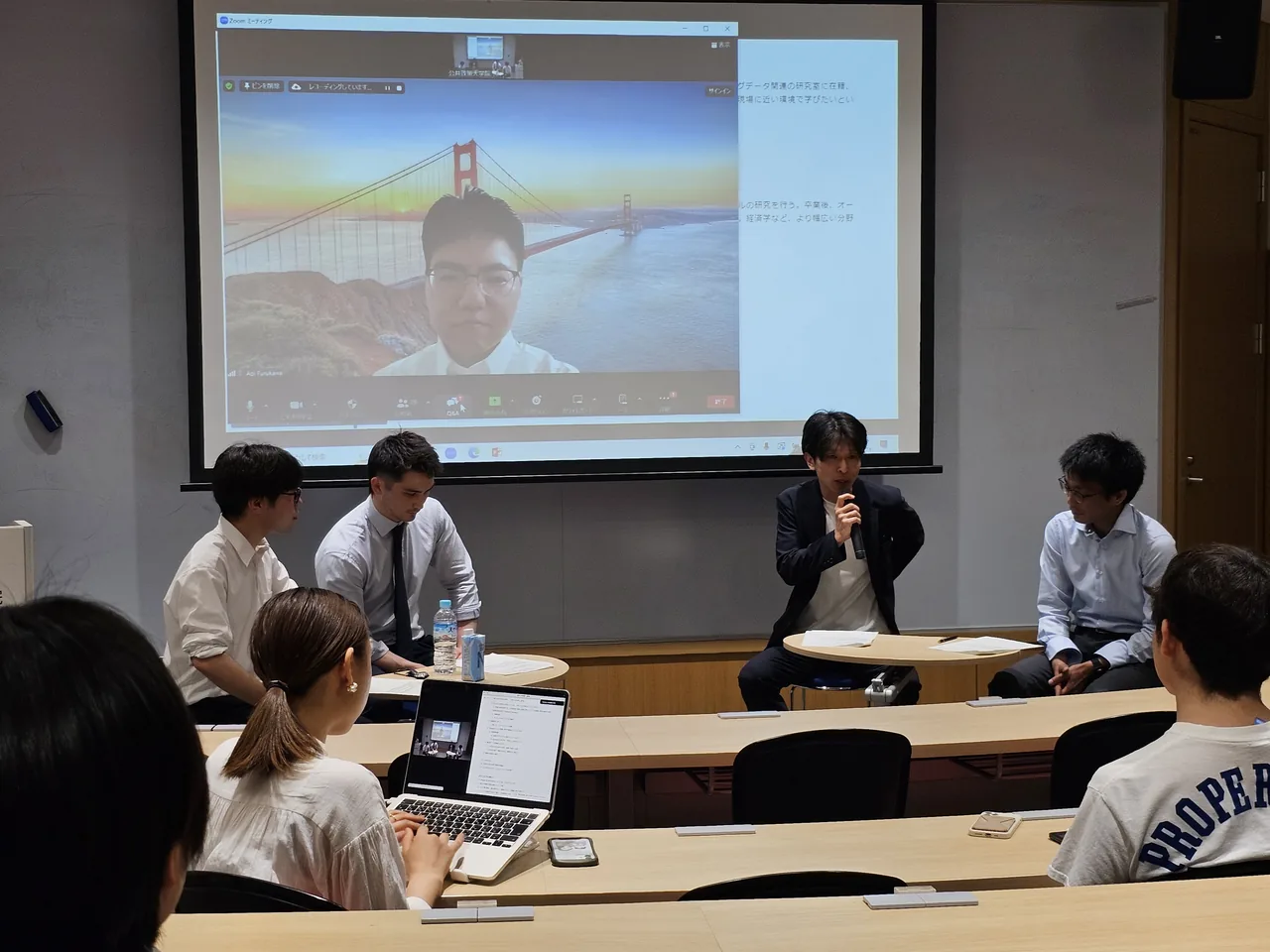
*This article has been edited based on the talk given at the public policy talk event “STEM × Public Policy” held on May 18, 2024.